

FREE SCIENCE NOTES |CLASS 10 PHYSICS NOTES
Ray Diagrams of Spherical Mirrors
🌟 Ray Diagrams of Spherical Mirrors (FULL EXAM MASTER NOTES)
🧠 1. CORE IDEA (MOST IMPORTANT)
👉 An object has many rays, but we use only 2 rays to find image
🧠 SUPER TRICK:
👉 “2 Rays = Full Image”
🎯 2. GOLDEN RULE OF IMAGE FORMATION
👉 Image is formed where:
👉 2 reflected rays meet OR appear to meet
🧠 TRICK:
👉 “Meet = Real Image”
👉 “Appear = Virtual Image”
✏️ 3. FOUR IMPORTANT RAYS (MUST REMEMBER ⭐⭐⭐)
(1) PARALLEL RAY
👉 Parallel to principal axis:
Concave → passes through F
Convex → appears from F
(2) FOCUS RAY
👉 Ray through focus:
Concave → becomes parallel
Convex → directed towards F → becomes parallel
(3) CENTRE OF CURVATURE RAY
👉 Ray through C:
Returns same path (acts like normal)
👉 “C → Come back”
(4) POLE RAY
👉 Ray hitting pole:
Reflects with i = r
👉 “Pole → Follow law (i = r)”
Light – Reflection and Refraction
5. CONCAVE MIRROR SUMMARY
🌟 Outside Focus (Beyond F)
👉 Image:
Real
Inverted
🌟 Inside Focus (Between F & P)
👉 Image:
Virtual
Erect
🧠 MASTER TRICK:
👉 “Outside F → Real”
👉 “Inside F → Virtual”
🔵 6. CONVEX MIRROR SUMMARY
👉 Always:
Image behind mirror
Virtual
Erect
Small
🎯 7. USES OF CONCAVE MIRROR (IMPORTANT)
🔦 1. Torch / Headlights
👉 Produce parallel rays
🪞 2. Shaving Mirror
👉 Gives large image
🦷 3. Dentist Mirror
👉 Enlarged view of teeth
☀️ 4. Solar Furnace
👉 Concentrates sunlight → heat
“Want to master the next concept? Click below and keep learning!”

FREE SCIENCE NOTES |CLASS 10 PHYSICS NOTES
Mirror Numericals Made Easy
SOLVING NUMERICALS (STEP-BY-STEP)
🎯 STEP 1:
Write formula
👉 1/f = 1/v + 1/u
f→Focal length
f→–ve →(concave)
f→ +ve→ (convex)
🎯 STEP 2:
Put correct signs
v=image distance in convex mirror(positive"+")
v=image distance in concave mirror(negative"-")
u=object distance in concave & convex mirror(negative"-")
🎯 STEP 3:
Solve using LCM
🎯 STEP 4:
Find magnification
👉 m = –v/u
m → magnification
v → image distance
u → object distance
👉 m = h′/h
m → magnification
h′ → height of image
h → height of object
+h′ → erect
–h′ → inverted
Light – Reflection and Refraction
✅ m = h′/h = –v/u
👉 h′/h = –v / u
👉 h′ = –v × h / u
🧠 TRICK:
👉 “Magnification = Image/Object”
📌 If m is NEGATIVE:
👉 Image is Real & Inverted,Enlarged Image
|m| > 1 → Enlarged
📌 If m is POSITIVE:
👉 Image is Virtual & Erect, Diminished
|m| < 1 → small & diminished image
“Want to master the next concept? Click below and keep learning!”
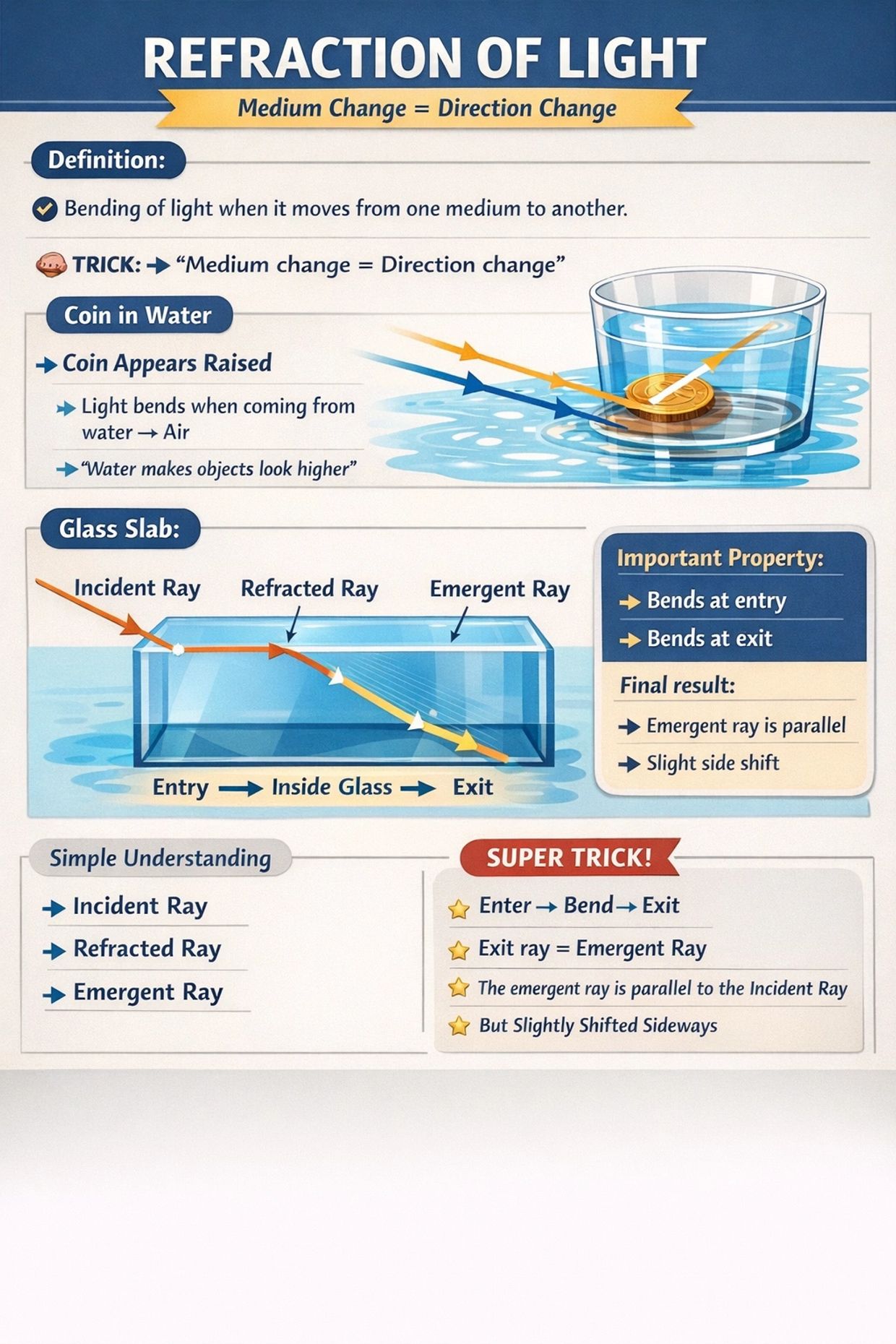
FREE SCIENCE NOTES |CLASS 10 PHYSICS NOTES
Refraction of Light Made Simple
REFRACTION OF LIGHT
✅ Definition:
👉 Bending of light when it moves from one medium to another
🧠 TRICK:
👉 “Medium change = Direction change”
🪙 Example
Coin in Water
👉 Coin appears raised
Reason:
👉 Light bends when coming from water to air
👉 “Water makes objects look higher”
🪙Glass Slab
👉 Light:
When light passes through a rectangular glass slab:
Enters glass → bends
Travels inside
Comes out → emergent ray
✨ Important Property:
Bends at entry
Bends at exit
👉 Final result:
✔ Emergent ray is parallel
✔ Slight side shift
Simple Understanding
Light enters a medium → called incident ray
Light bends inside → called refracted ray
Light comes out → called emergent ray
Light – Reflection and Refraction
🧠 SUPER TRICK: 👉 “Enter → Bend → Exit”
👉 Exit ray = Emergent Ray
👉 The emergent ray is parallel to the incident ray
👉 But slightly shifted sideways
“Want to master the next concept? Click below and keep learning!”

FREE SCIENCE NOTES |CLASS 10 PHYSICS NOTES
Laws of Refraction Made Easy
📐Laws of Refraction
📐 1. FIRST LAW OF REFRACTION
✅ Statement:
👉 The incident ray, refracted ray, and the normal at the point of incidence
👉 all lie in the same plane
🧠 TRICK:
👉 “IRN in One Plane” (I = Incident, R = Refracted, N = Normal)
📊 2. SECOND LAW OF REFRACTION (Snell’s Law) ⭐⭐⭐
✅ Statement:
👉 The ratio of sine of angle of incidence to sine of angle of refraction is constant
📌 Formula:
👉 sin i / sin r = constant
👉 This constant = Refractive Index (n)
🧠 TRICK:
👉 “Sin i / Sin r = Constant”
🌍 3. WHAT DOES IT MEAN?
👉 Light bends because its speed changes in different media"
Light – Reflection and Refraction
“Want to master the next concept? Click below and keep learning!”
FREE SCIENCE NOTES |CLASS 10 PHYSICS NOTES
Refractive Index Made Easy
REFRACTIVE INDEX (VERY IMPORTANT)
✅ Formula:
👉 n = sin i / sin r
👉 OR
👉 n = v₁ / v₂
✅ Absolute Refractive Index:
👉 n = c / v
🧠 TRICK:
👉 “n = speed ratio”
⚡ SPEED CONCEPT
👉 Vacuum:
👉 3 × 10⁸ m/s (fastest)
👉 In glass/water:
👉 Slower
🧠 TRICK:
👉 “Vacuum fastest, glass slow”
👉 Optical density ≠ mass density
📌 Rule:
👉 Higher refractive index → more optical density
🧠 TRICK:
👉 “High n = Strong bending”
Light – Reflection and Refraction
🔥BENDING RULE (VERY IMPORTANT)
📌 Rarer → Denser: 👉 Bends towards normal 📌 Denser → Rarer: 👉 Bends away from normal
🧠 MASTER TRICK:
👉 “Enter dense → Bend in”
👉 “Exit dense → Bend out”
📊 IMPORTANT VALUES Medium Refractive Index Air~1
Water ~1.33
Glass~1.5
Diamond~2.42
🧠 TRICK:
👉 “Diamond bends maximum”
“Want to master the next concept? Click below and keep learning!”
free science notes |class 10 physics notes
Spherical Mirror Concepts Made Easy | All Definitions, Tricks & Formulas
✔ (1) Pole (P)
✅ Definition:
👉 Centre point of mirror surface
🧠 TRICK: 👉 “Pole = Point on mirror”
✔ (2) Centre of Curvature (C)
✅ Definition:
👉 Centre of the sphere of which mirror is a part
Concave → in front
Convex → behind
🧠 TRICK: 👉 “Concave = C Comes forward”
👉 “Convex = C goes back”
✔ (3) Radius of Curvature (R)
✅ Definition:
👉 Distance between P and C
👉 R = PC
🧠 TRICK: 👉 “R = Distance to Centre”
✔ (4) Principal Axis
✅ Definition:
👉 Straight line joining P and C
👉 Normal at pole
🧠 TRICK: 👉 “Axis = Always through P & C”
✔ (5) Principal Focus (F)
✅ Definition:
👉 Point where rays parallel to principal axis:
Concave → actually meet
Convex → appear to meet
🧠 TRICK: 👉 “Concave = Real Meet”
👉 “Convex = Fake Meet”
Reflection of Light
✔ (6) Focal Length (f)
✅ Definition:
👉 Distance between P and F
👉 f = PF
🧠 TRICK: 👉 “f = focus distance”
✔ (7) Aperture
✅ Definition:
👉 Diameter of mirror (MN)
🧠 TRICK: 👉 “Aperture = Opening size”
✔ IMPORTANT RELATION
📌 Formula:
👉 R = 2f
👉 f = R/2
🧠 TRICK: 👉 “R is Double of f”
“Want to master the next concept? Click below and keep learning!”

free science notes |class 10 physics notes
Laws, Mirrors & Image Formation Explained
✔ Light is necessary to see objects
✔ Objects are visible due to reflection of light
✔ Light travels in straight line
✔ Transparent materials allow light to pass
✔ Diffraction shows bending of light
✔ Light has dual nature (wave + particle)
✔ Optical phenomena include rainbow, mirrors, etc.
✔ Light is necessary to see objects
✔ Objects are visible due to reflection of light
✔ Light travels in straight line
✔ Transparent materials allow light to pass
✔ Diffraction shows bending of light
✔ Light has dual nature (wave + particle)
✔ Optical phenomena include rainbow, mirrors, etc.
Reflection of Light
👉 No light → no vision
👉 Objects reflect light
👉 Light travels straight
👉 Shadow proves straight path
👉 Small object → bending (diffraction)
👉 Light = wave + particle
“Want to master the next concept? Click below and keep learning!”

FREE SCIENCE NOTES |CLASS 10 PHYSICS NOTES
How Do We See Through Medium? Transparent, Translucent & Opaque Explained
HOW DO WE SEE THROUGH MEDIUM?
Types of Materials:
Type Meaning Example
Transparent Light passes fully Glass, Water
Translucent Light passes partially Paper, Fog
Opaque Light does not pass Wall, Wood
FREE SCIENCE NOTES |CLASS 10 PHYSICS NOTES
Laws, Mirrors & Image Formation Explained
✅ What is Reflection?
👉 When light falls on a surface and bounces back, it is called reflection.
LAWS OF REFLECTION
📌 Law 1:
👉 Angle of Incidence = Angle of Reflection
Represented as:
∠i = ∠r
📌 Law 2:
👉 Incident ray, reflected ray, and normal all lie in same plane
✅PLANE MIRROR
IMAGE PROPERTIES
📌 Key Properties:
Property Explanation
Virtual Cannot be caught on screen
Erect Straight image
Same size Equal to object
Same distance Image distance = Object distance
Laterally inverted Left ↔ Right reversed
✅LATERAL INVERSION
Meaning:
👉 Left becomes right and right becomes left
SPOON ACTIVITY (IMPORTANT FOR EXAM)
A spoon behaves like a spherical mirror:
✨ Front side (Inner side):
👉 Acts like concave mirror
Near → Image erect & large
Far → Image inverted
✨ Back side (Outer side):
👉 Acts like convex mirror
Always small & erect
Reflection of Light
✅ SPHERICAL MIRRORS
Definition:
👉 Mirrors whose reflecting surface is part of a sphere
Types:
Concave Mirror (Curved inward)
Convex Mirror (Curved outward)
MOST IMPORTANT EXAM POINTS
✔ Reflection = bouncing of light
✔ i = r (must remember)
✔ All rays lie in same plane
✔ Plane mirror forms:
Virtual
Erect
Same size
Laterally inverted
✔ Spoon experiment → proves curved mirrors
✔ Two types of spherical mirrors:
1.Concave 2. Convex
“Want to master the next concept? Click below and keep learning!”